
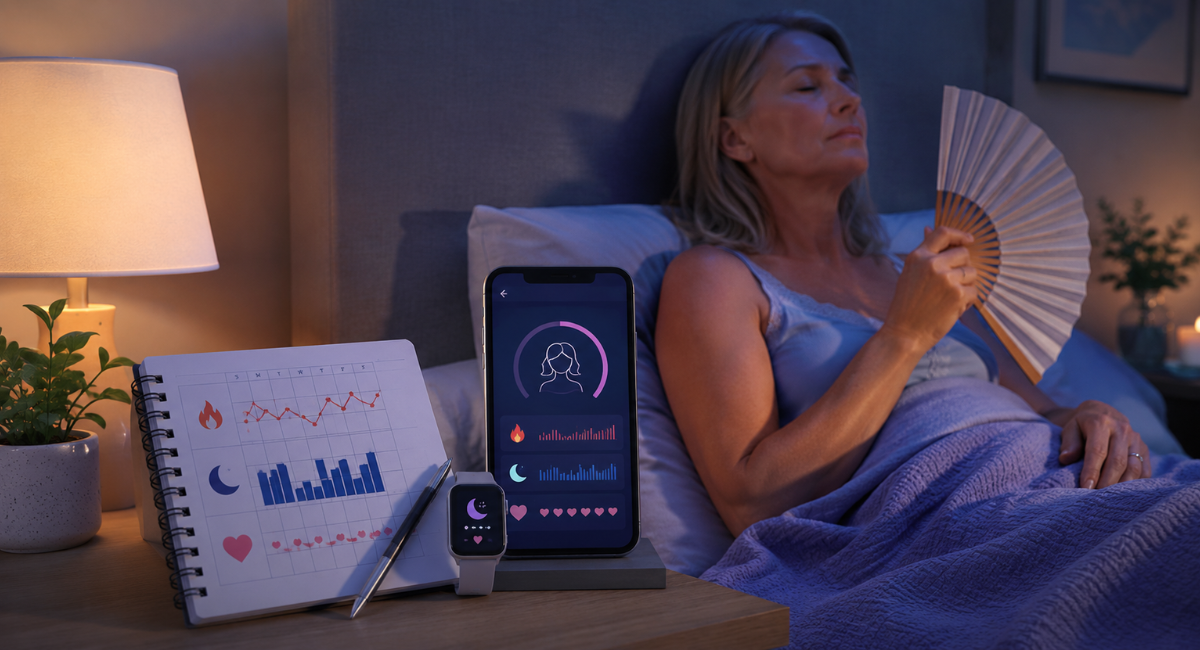
Medical Disclaimer: This article is for informational purposes only and does not constitute medical advice. Menopause symptoms vary. Tracking tools described are for self‑management, not medical diagnosis. Always consult your healthcare provider for persistent or severe symptoms.
📞 Before you start tracking: If you experience very heavy night sweats, unexplained weight loss, or extreme fatigue, see a doctor first. Tracking is a helpful tool, but it should never delay professional medical evaluation.
“I have no idea what triggers my hot flashes. They just appear.”
That’s what my neighbor Elena told me last month. She’s 51, in perimenopause, and she feels completely out of control.
One night, she sleeps fine. The next night, she’s drenched. Some days, coffee seems to cause a flash. Other days, it doesn’t.
“I can’t find any pattern,” she said. “How am I supposed to fix something I don’t understand?”
I smiled and handed her a simple tool – a tracking log. The same one I’m sharing with you.
This article is for anyone who:
- Wants to understand what triggers their hot flashes
- Needs to prove to their doctor how severe their symptoms are
- Has tried random solutions without knowing if they work
- Desires a sense of control over unpredictable menopause symptoms
The short answer: Tracking your hot flashes and sleep patterns helps you identify triggers, measure treatment effectiveness, and have more productive conversations with your doctor.
Here is the key insight: When you log your symptoms consistently for just two weeks, patterns will emerge that you never noticed before.
Why Tracking Matters More Than You Think
Let’s be honest: memory is unreliable. After a bad night, you might think you had five hot flashes. In reality, you had two. After a good night, you might forget the one brief flash that woke you up.
Tracking removes guesswork. It transforms vague complaints into hard data.
Here is what consistent tracking can reveal:
- Specific triggers: Does caffeine always cause a flash? Does alcohol? Does stress?
- Circadian patterns: Do your hot flashes peak at a certain time of day or night?
- Treatment effectiveness: Is that new herbal supplement actually working?
- Sleep disruption: Are hot flashes waking you up, or is it something else?
Research shows that self‑monitoring of symptoms improves self‑management and clinical outcomes for many chronic conditions. For menopause, tracking helps both you and your doctor make better decisions.
What Exactly Should You Track? (The Essential List)
Before you start, decide which data points matter most to you. Too many columns can be overwhelming. Stick with the essentials first.
Must‑Track Items (Minimum Viable Log)
| Item | Why It Matters |
|---|---|
| Date | Establishes a timeline |
| Time of hot flash | Reveals circadian patterns |
| Intensity (1‑10 scale) | Measures severity, not just frequency |
| Duration (minutes) | Short vs. long flashes matter |
| Sleep quality (1‑10 scale) | Connects flashes to restfulness |
| Night sweats (yes/no) | Differentiates daytime vs. nighttime |
Optional But Helpful Additions
| Item | Why You Might Add It |
|---|---|
| Food/drink before flash | Identifies dietary triggers |
| Stress level (1‑10) | Links anxiety to symptoms |
| Medication/supplements | Tracks what you took and when |
| Room temperature | Helpful for night sweats |
| Exercise (type/time) | Reveals exercise triggers or relief |
Start with the must‑track list for the first week. Then add optional items based on what you suspect might be affecting you.
The Best Methods to Track (From Low‑Tech to High‑Tech)
There is no one “right” way to track. Choose what fits your lifestyle.
Method 1: Paper Log (Best for Beginners)
A simple notebook or printed template works beautifully. Keep it on your nightstand with a pen. When you wake up from a flash, jot down the time and intensity while it’s fresh in your mind.
Pros: No learning curve, always available, satisfying to fill out.
Cons: Harder to spot long‑term patterns, easy to lose.
Method 2: Spreadsheet (Best for Data Lovers)
Use Excel, Google Sheets, or Apple Numbers. Create columns for each data point. Use conditional formatting to color‑code severe flashes red and mild flashes green.
Pros: Easy to sort, filter, and chart. Always backed up.
Cons: Requires a computer or tablet, which may not be next to your bed.
Method 3: Smartphone Apps (Best for Consistency)
Several excellent apps are designed for menopause tracking. Your phone is always within reach, making it easy to log a flash immediately.
Pros: Automated charts, reminders, data export.
Cons: Screen light might disrupt sleep if you log at night.
Method 4: Wearable Devices (Best for Passive Tracking)
Smartwatches and fitness trackers (Oura Ring, Fitbit, Apple Watch) can detect changes in skin temperature, heart rate, and sleep stages. They cannot identify a hot flash with 100% accuracy, but they provide objective data that you can correlate with your manual logs.
Pros: Passive, continuous, highly detailed.
Cons: Expensive, not specifically designed for menopause.
How to Create Your Own Hot Flash and Sleep Log (Printable Template)
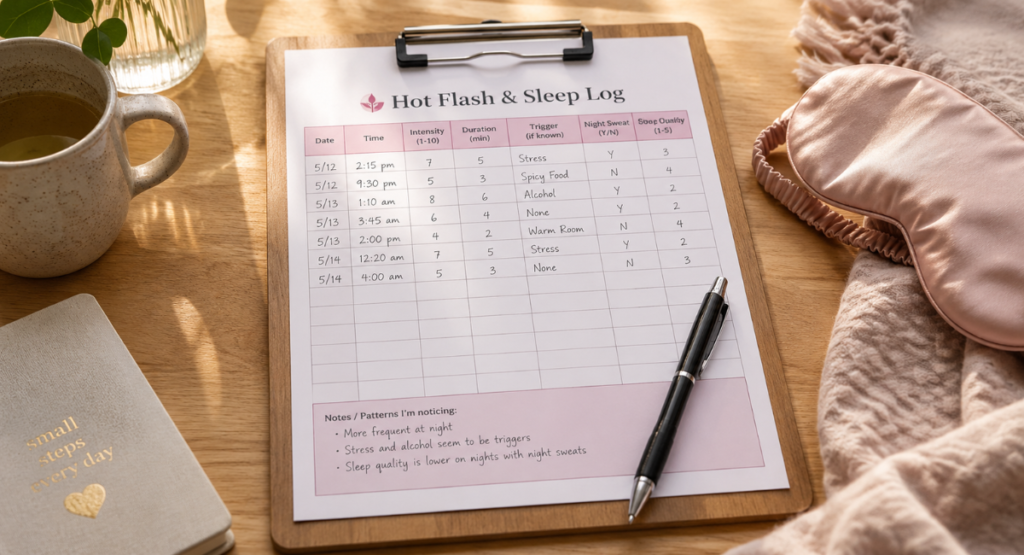
Here is a simple layout you can recreate in a notebook or spreadsheet. Use it for at least two weeks.
| Date | Time | Intensity (1‑10) | Duration (min) | Possible Trigger | Night Sweat? | Sleep Quality (1‑10) |
|---|---|---|---|---|---|---|
| 4/29 | 2:15 AM | 8 | 12 | Red wine at dinner | Yes | 4 |
| 4/29 | 6:30 AM | 3 | 5 | Morning coffee | No | N/A |
| 4/30 | 3:00 AM | 9 | 15 | Stressed before bed | Yes | 3 |
Pro tip: Add a “Notes” column for anything unusual – a fight with your partner, a late meal, a hot day.
The Best Apps for Tracking Hot Flashes and Sleep
Here are four highly rated, menopause‑specific apps. All offer free versions.
1. Balance (by Dr. Louise Newson)
This award‑winning app is completely free and packed with evidence‑based information. You can log symptoms daily, track cycles, and generate charts to share with your doctor.
Best for: Women who want a comprehensive, reputable, zero‑cost solution.
2. menopause: Health & Symptom Tracker
Simple and focused. Log hot flashes, night sweats, mood, and sleep. View trends over days, weeks, or months.
Best for: Women who want a minimalist, no‑distraction tracker.
3. MySysters
Designed by a team of women’s health experts. Tracks not just hot flashes but also sleep, mood, and cognitive symptoms (“brain fog”). Offers exportable reports for your doctor.
Best for: Women who want to track multiple symptom types simultaneously.
4. Clue (Perimenopause Mode)
Clue is primarily a period tracker, but it has a robust perimenopause mode. You can log symptoms, get insights, and connect with a community.
Best for: Women who are still having irregular periods and want to track both cycles and vasomotor symptoms.
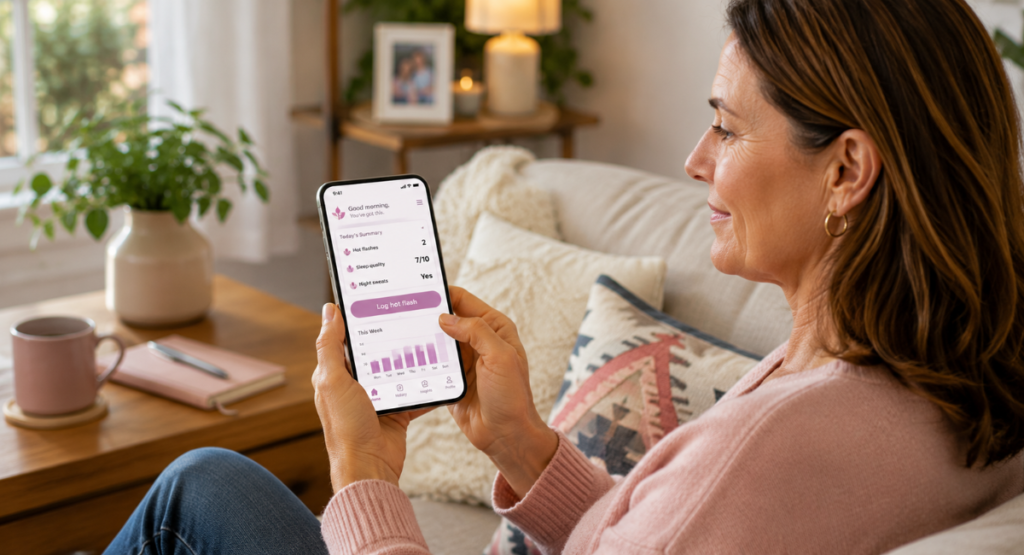
All of these apps allow you to export your data, which is invaluable for a doctor’s appointment.
How to Spot Patterns in Your Tracking Data
Collecting data is useless if you don’t analyze it. After two weeks, sit down with your log and look for answers to these questions.
Question 1: Is There a Time of Day Pattern?
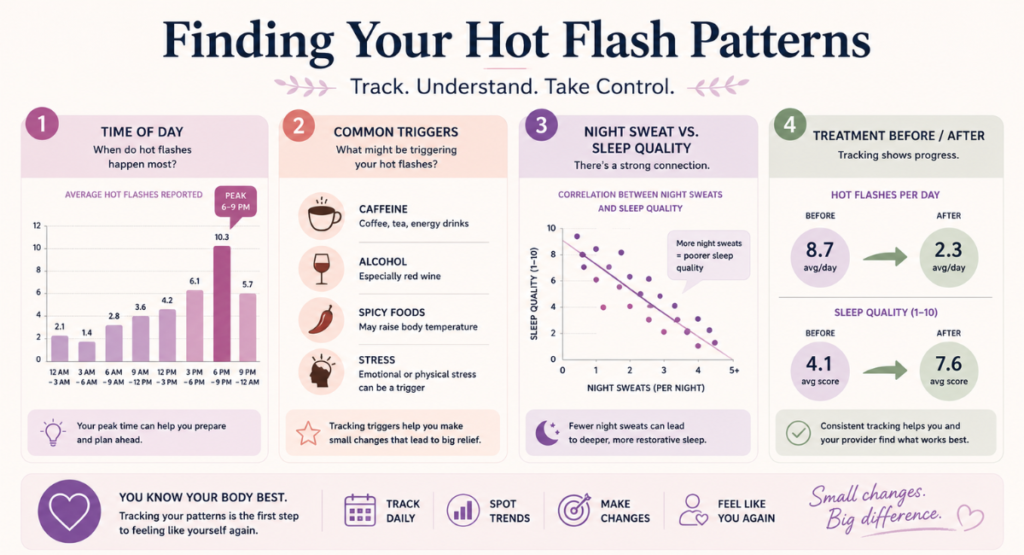
Do your hot flashes cluster around the same time each day? For many women, the peak is between 3 PM and 9 PM, with a secondary peak in the early morning hours. Knowing your personal pattern allows you to prepare cooling strategies proactively.
Question 2: What Triggers Precede Your Flashes?
Look at the “Possible Trigger” column. Do you see any repeats? Common triggers include caffeine, alcohol, spicy foods, stress, warm rooms, and tight clothing. If you suspect a trigger, test it by removing it for a week and comparing your logs.
Question 3: How Much Are Night Sweats Affecting Your Sleep?
Compare your “Night Sweat” column with your “Sleep Quality” score. If every night sweat night has a low sleep score, then cooling your bedroom (and yourself) should be your top priority. If your sleep score is low even without night sweats, your insomnia may have other causes.
Question 4: Is Your Treatment Actually Working?
Did you start a new herbal supplement or adjust your hormone therapy? Compare two weeks before and two weeks after. Look for changes in average intensity, frequency, and sleep quality.
Real‑Life Examples: How Tracking Changed Everything
Margaret, 54 (perimenopause): “I was convinced my hot flashes were random. After two weeks of tracking, I saw a clear pattern: they peaked around 7 PM, and they were always worse after a day with high stress. I started doing deep breathing at 6 PM and avoided arguments in the evening. My flashes dropped by 40%.”
Sarah, 59 (post‑menopause): “My doctor didn’t believe me when I said I had twelve night sweats per week. I brought in my tracking log. She immediately changed my treatment plan. The data gave me credibility.”
Linda, 52 (perimenopause): “I tried three different supplements over six months. I thought none worked. Then I reviewed my log and realized one of them had actually reduced my flash intensity from 8 to 5. I would have stopped it if I hadn’t tracked.”
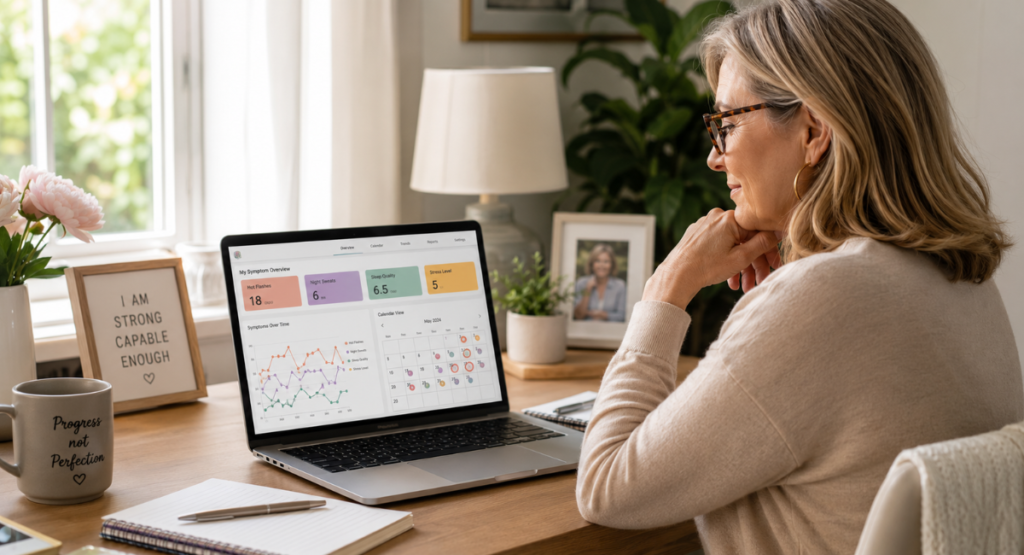
Case Study: One Woman, 30 Days of Tracking
Subject: Diane, 53, perimenopause. Complaints: 5‑7 hot flashes per day, 3‑4 night sweats per week, poor sleep.
Method: Used Balance app for 30 days. Tracked time, intensity, possible triggers, and sleep quality.
Findings after 30 days:
- 78% of flashes occurred between 6 PM and 10 PM
- 64% followed a meal containing spicy food or caffeine
- Night sweat nights had sleep quality scores of 2‑4 (scale 1‑10)
- Non‑night‑sweat nights had scores of 6‑8
Actions taken:
- Stopped eating spicy foods after 4 PM
- Cut caffeine entirely after 2 PM
- Added a cooling mattress topper (from earlier in this series)
Result after next 30 days:
- Hot flash frequency down 45%
- Night sweats down to 1‑2 per week
- Average sleep quality up to 6
Lesson: Tracking provided the evidence Diane needed to change her behavior with confidence.
Myth vs. Fact: Tracking Edition
| Myth | Fact |
|---|---|
| “You need to track everything to get useful data.” | False. Start with just time, intensity, and sleep quality. Add more only if needed. |
| “Menopause symptoms are too random to track.” | False. Most women have clear circadian and trigger patterns. You just haven’t looked for them yet. |
| “Apps are better than paper.” | Not necessarily. The best method is whichever you will actually use consistently. |
| “Once you find your pattern, you can stop tracking.” | Not recommended. Symptoms can change over time. Track for 2‑4 weeks every few months. |
Common Mistakes to Avoid
- Tracking too many things at once – You will burn out. Start with 3‑5 columns. Add more later if needed.
- Logging from memory at the end of the day – Memory is unreliable. Log each flash immediately or as soon as you wake up.
- Not including sleep quality – Hot flashes and sleep are deeply connected. Always rate your sleep quality each morning.
- Ignoring “good” days – Track even when you have no symptoms. Your doctor needs to know the frequency of zero‑flash days too.
- Never reviewing the data – Tracking without analysis is a waste of time. Set a calendar reminder every two weeks to review your log.
- Using screen light at night – If you use your phone to log a flash, turn the brightness all the way down or use a red‑light filter. Blue light worsens sleep.
Who Should Not Rely Solely on Self‑Tracking
⚠️ Tracking is not a substitute for medical care. See a doctor if you experience:
- Soaking night sweats that require changing bedding every night
- Unexplained weight loss
- Fever, chills, or night sweats accompanied by fatigue
- Chest pain or shortness of breath
- Depressed mood or thoughts of self‑harm
Track your symptoms, but never delay medical evaluation.
Frequently Asked Questions
How long do I need to track before I see a pattern?
Most women see clear patterns after 10‑14 days of consistent logging. Some as early as 7 days. Track for a full menstrual cycle if you still have periods.
Can I use my fitness tracker instead of a manual log?
You can use both. A fitness tracker provides passive data on skin temperature, heart rate, and sleep stages. However, it cannot tell you what you ate, how stressed you felt, or whether that flash was mild or severe. Combine passive data with manual logging for the full picture.
What if I wake up at night to log a flash?
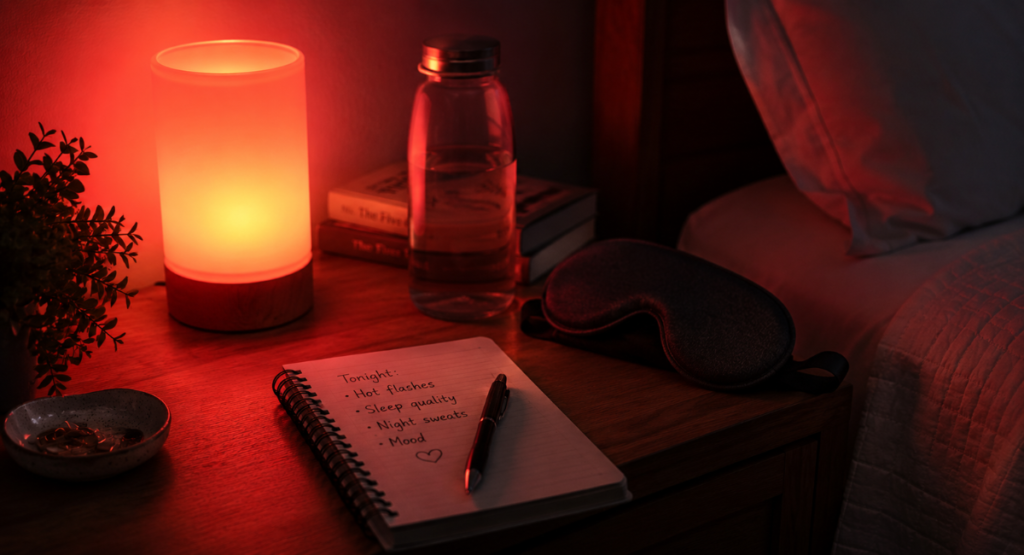
Keep your log and a dim red light (or a pen with a tiny LED) on your nightstand. Do not turn on overhead lights or look at a bright phone screen. Write down the time and intensity, then go back to sleep.
How do I share my tracking data with my doctor?
Most apps allow you to export a PDF or CSV file. If you use paper, take a clear photo of your log or photocopy it. Highlight the most important patterns (e.g., “night sweats 5x/week, sleep quality 2/10”).
What should I do if I see no pattern after three weeks?
First, make sure you tracked consistently without gaps. Then, add more columns: track room temperature, stress level (1‑10), and everything you eat for a week. Some triggers are subtle. Also, consider that your symptoms may be truly random – which is still useful information for your doctor.

Bring your tracking log to your doctor’s appointment. Hard data leads to better conversations and more effective treatments.
Your 2‑Week Tracking Action Plan (Printable Checklist)
[Image: Two‑week tracking action plan checklist – alt text: “Printable checklist for two weeks of hot flash and sleep tracking”]
Placement: After this section
Caption: “Start small. Choose one tracking method and commit to two weeks. You can do this.”
| Week | Action | Completed |
|---|---|---|
| Week 1 | Choose your tracking method (paper, spreadsheet, app, or wearable) | ☐ |
| Week 1 | Set up your log with must‑track columns (date, time, intensity, duration, night sweat, sleep quality) | ☐ |
| Week 1 | Place your log and a pen within arm’s reach of your bed | ☐ |
| Week 1 | Log every flash the same day it happens | ☐ |
| Week 2 | Continue logging daily | ☐ |
| Week 2 | Add one optional column (possible triggers) | ☐ |
| End of Week 2 | Review your data for time‑of‑day and trigger patterns | ☐ |
| End of Week 2 | Export or photocopy your log for your doctor | ☐ |
My Final Verdict: You Can’t Change What You Don’t Measure
Tracking your hot flashes and sleep patterns is not about obsessing over every symptom. It is about gathering enough evidence to make smarter decisions.
Start with a simple paper log for two weeks. That is all it takes. You will likely discover one or two triggers you never suspected. You will also have concrete data to show your doctor.
After tracking, you can stop. Track again a few months later to see if your patterns have changed. Adjust your strategies accordingly.
Ready to take control? [Click here] to download my free printable hot flash and sleep tracking log (PDF).
See my recommended apps and wearable devices for automated tracking.
Medical References & Trusted Sources
- The North American Menopause Society – “Keeping a symptom diary”
- Journal of Women’s Health – “Self‑monitoring of menopausal symptoms improves clinical outcomes”
- Balance Menopause App – Evidence‑based symptom tracking (Dr. Louise Newson)
- MySysters App – Designed by women’s health experts
- Clue App – Perimenopause mode research
Medical Disclaimer (repeated): This article is for informational purposes only. Tracking tools are for self‑management, not medical diagnosis. Always consult your healthcare provider for persistent or severe symptoms.
Last updated: April 29, 2026
Published: April 29, 2026