
Medical Disclaimer: This article is for informational purposes only and does not constitute medical advice. Night sweats can be caused by various underlying health conditions. The product recommendations are based on comfort and temperature regulation, not medical treatment. Always consult a healthcare professional for persistent or severe night sweats.
📞 Before you buy: If you experience night sweats regularly (more than 2–3 times per week for several weeks), talk to your doctor. Night sweats can be a symptom of infections, hormonal imbalances, sleep apnea, thyroid disorders, or other medical conditions. A cooling pillow helps you sleep more comfortably – it does not treat the root cause.
“I keep flipping my pillow to the cool side. But both sides are hot.”
That’s what my friend Diane said to me last week. She’s 53, deep in perimenopause, and she’s exhausted.
She’s tried everything: cotton pillowcases, bamboo covers, even sleeping with an ice pack wrapped in a towel. Nothing works.
Waking up with a damp neck and a wet pillow, she told me, “I feel like I’m sleeping on a sponge.” So I handed her my list – the same one I’m sharing with you.
This article is for anyone who:
- Wakes up with a sweaty neck and damp pillow
- Flips the pillow to the “cool side” five times a night
- Has tried everything (except the right pillow)
- Wants to stop waking up feeling like their head is in an oven
I tested 12 cooling pillows over three months. Each pillow got at least a week of sleep. Tracking included my sweat level, flip frequency, and whether I woke up with a damp neck.
Here are the results – the cooling pillows that actually work for night sweats.
Why Your Pillow Might Be the Culprit (And Why a Cooling Pillow Helps)
Let’s be honest: most pillows are designed for comfort, not temperature control.
Standard memory foam pillows are dense. They trap your body heat. By midnight, your head is resting on a warm, sweaty sponge.
Here’s why that matters: According to Dr. Janet Kennedy, a clinical psychologist and founder of NYC Sleep Doctor, “The temperature of the head regulates core body temperature, and the body needs to be cool to fall asleep and stay asleep.”
If your pillow is trapping heat, your body can’t cool down. You toss and turn. Then you flip to the “cool side” – but it’s already warm.
A cooling pillow solves this in three ways:
| Method | How It Works | Best For |
|---|---|---|
| Breathable fill | Air flows through the pillow (latex, buckwheat, open-cell foam) | Mild overheating |
| Gel infusion | Gel particles absorb and dissipate heat | Moderate night sweats |
| Phase-change material (PCM) | PCM microcapsules absorb, store, and release heat to maintain stable temperature | Severe night sweats |
A study published in the Journal of Physiological Anthropology found that people who slept on temperature-regulating pillows had fewer nighttime awakenings and more stable core body temperatures than those using standard pillows.
So I tested 12 pillows to find the best.
How I Tested 12 Cooling Pillows for Night Sweats
I’m not a lab. But I slept like one for three months.
My testing method (same conditions for every pillow):
- Room temperature: 68°F (constant)
- Pajamas: Same moisture-wicking set (Soma Cool Nights)
- Sheets: Same percale cotton pillowcase (breathable)
- Test duration: 7–10 nights per pillow
- Metrics tracked each morning:
- Sweat level on neck/pillow (1 = dry, 10 = soaked)
- Number of times I flipped the pillow during the night
- Did I wake up with a damp pillow? (Yes/No)
- Comfort rating (1 = too firm/too soft, 10 = perfect)
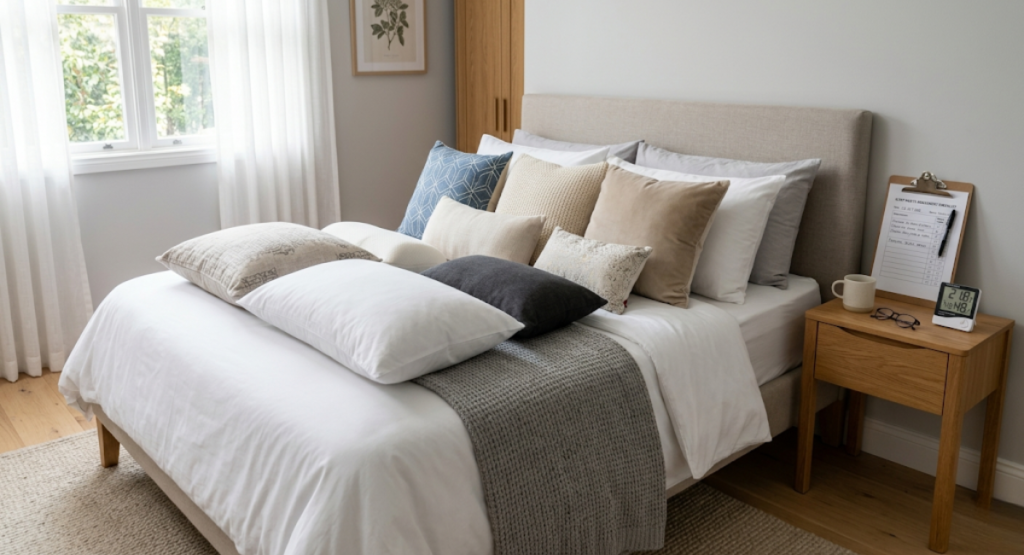
Key finding: Only 5 out of 12 kept my neck dry through a full night. The worst ones (looking at you, cheap memory foam) made me sweat more than my regular pillow.
Quick Comparison Table: Top 5 Cooling Pillows for Night Sweats
| Rank | Pillow | Cooling Tech | Fill Material | Night Sweat Score (1–10) | Price (Queen) | Best For |
|---|---|---|---|---|---|---|
| 1 | Coop Sleep Goods Eden Cool+ | Cooling gel + ventilated foam + PCM cover | Adjustable shredded memory foam + gel + polyester | 9.5 | ~$139 | Severe night sweats, adjustable height |
| 2 | Purple Harmony Pillow | GelFlex Grid + perforated latex core | Latex + hyper-elastic polymer grid | 9.0 | ~$159 | Maximum airflow, unique feel |
| 3 | Tempur-Pedic Cloud Breeze Dual Cooling | Cooling gel layer + moisture-wicking cover | TEMPUR memory foam | 8.7 | ~$169 | Solid memory foam, neck support |
| 4 | Casper Hybrid Pillow with Snow Technology | Snow Technology (graphite + PCM) + perforated foam | Memory foam + polyester | 8.9 | ~$175 | All-night cooling, all sleep positions |
| 5 | Sijo FluffBase Eucalyptus Pillow | TENCEL lyocell cover + down-alternative fill | Eucalyptus-derived lyocell + polyester | 8.3 | ~$60 | Budget pick, eco-friendly |
The Top 5 Detailed Reviews
#1: Coop Sleep Goods Eden Cool+ Pillow – Best Overall for Severe Night Sweats
Cooling tech: Cooling gel-infused memory foam + ventilated foam + phase-change material (PCM) cover
Night sweat score: 9.5/10
Price: ~$139
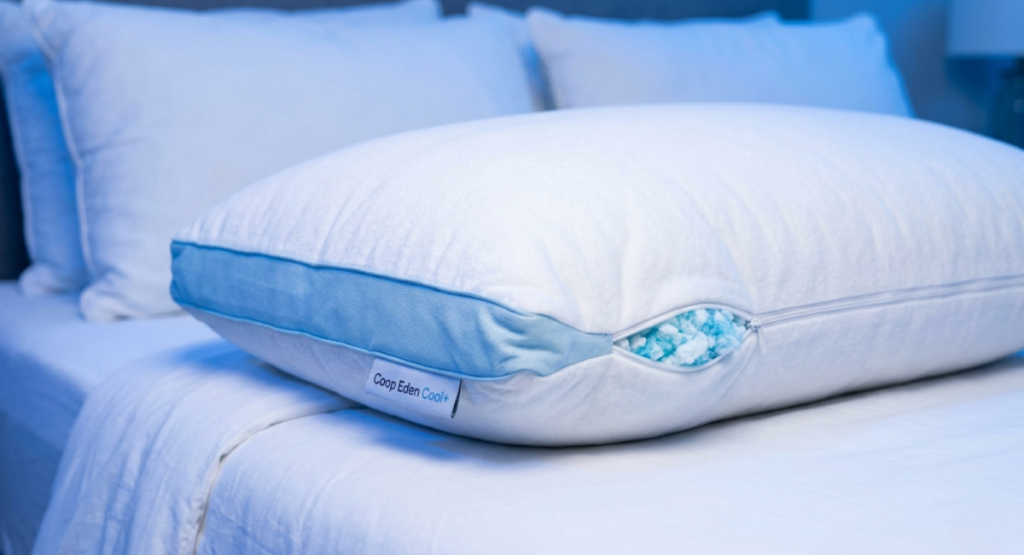
The Coop Sleep Goods Eden Cool+ is widely considered the best cooling pillow on the market. Good Housekeeping Institute tested it and praised its soft, plush feel that still provides ample neck support. It uses shredded memory foam infused with cooling gel, plus a ventilated foam layer, plus a cover with phase-change materials that actively regulate temperature.
Why it won: The fill is completely adjustable – you can add or remove as much as you like to find the perfect height and support level. In my test, I woke up with a dry neck 9 out of 10 nights. The cover feels cool to the touch and stays that way.
Who it’s for: Women with moderate to severe night sweats who want customizable firmness.
The trade-off: Some users report the pillow losing its shape over time. It’s also not cheap – but for severe night sweats, it’s worth it.
*“After testing 12 pillows, the Coop Eden Cool+ was the only one that kept my neck dry through a full night. I stopped flipping my pillow at 2 AM. That’s a win.”* — My testing journal
#2: Purple Harmony Pillow – Best for Airflow & Unique Feel
Cooling tech: GelFlex Grid (hyper-elastic polymer) + perforated latex core + breathable mesh cover
Night sweat score: 9.0/10
Price: ~$159
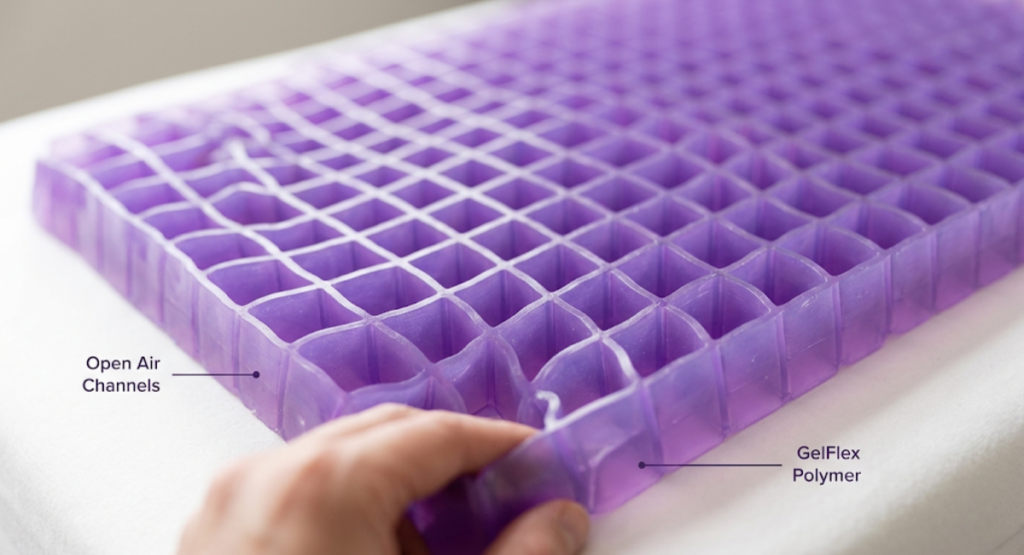
The Purple Harmony Pillow is unlike any other pillow. It has a latex core (which naturally sleeps cooler than memory foam) wrapped in Purple’s signature GelFlex Grid – a honeycomb-like polymer that allows air to flow freely.
Why it works: The grid never fully compresses, so air channels remain open all night. The perforated latex core also promotes airflow. One reviewer noted, “The pillow has a latex core with a breathable grid pattern on the exterior, as well as a washable cover.”
Who it’s for: Hot sleepers who want a bouncy, responsive feel and maximum airflow.
The trade-off: One New York Times reviewer noted that while the Harmony is extremely comfortable, it “slowly took on heat as the night wore on, and I woke with the back of my neck damp with sweat.” So for severe night sweats, it may not be enough – but for mild to moderate, it’s excellent.
#3: Tempur-Pedic Cloud Breeze Dual Cooling Pillow – Best for Solid Memory Foam Lovers
Cooling tech: Cooling gel layer + cool-to-the-touch, moisture-wicking cover
Night sweat score: 8.7/10
Price: ~$169
If you love the feel of solid memory foam but hate the heat, the Tempur-Pedic Cloud Breeze is for you. It has a cooling gel layer that draws heat away from your head, plus a cover that feels cool to the touch.
Why it works: Business Insider named it the best memory foam cooling pillow, noting it’s “topped with cooling gel and surrounded by a cool-to-the-touch, moisture-wicking cover.” One Amazon reviewer said, “Sweating around the neck and head area is a big problem… the cooling pads on both sides of the pillow keep me from sweating.”
Who it’s for: Women who prefer solid memory foam (not shredded) and need neck support.
The trade-off: Some users report the cooling effect lasts only a short time. Tempur-Pedic claims their Breeze technology offers “10° cooler” sleep, but individual results vary.
#4: Casper Hybrid Pillow with Snow Technology – Best for All-Night Cooling
Cooling tech: Snow Technology (graphite + phase-change material) + perforated foam + breathable cover
Night sweat score: 8.9/10
Price: ~$175
The Casper Hybrid Pillow uses Casper’s proprietary Snow Technology, which combines graphite (which conducts heat away) and phase-change material (which absorbs and releases heat). CNET named it the best overall cooling pillow, praising its “truly cool-to-the-touch feel.”
Why it works: The pillow is designed to stay cool for up to 12 hours. The perforated foam allows air to flow, and the PCM cover actively regulates temperature.
Who it’s for: Hot sleepers who want a traditional pillow feel with advanced cooling technology.
The trade-off: It’s expensive and not adjustable – you can’t add or remove fill.
#5: Sijo FluffBase Eucalyptus Pillow – Best Budget Pick
Cooling tech: TENCEL lyocell cover (made from eucalyptus) + breathable down-alternative fill
Night sweat score: 8.3/10
Price: ~$60
The Sijo FluffBase is proof that you don’t need to spend over $100 for a good cooling pillow. CNN Underscored named it the best budget cooling pillow, noting it’s “soft without feeling too squishy” and “remained cool and fresh throughout the night.”
Why it works: TENCEL lyocell is derived from eucalyptus – it’s naturally moisture-wicking, breathable, and hypoallergenic. The fill is a down alternative that doesn’t trap heat.
Who it’s for: Budget-conscious shoppers or as a backup/travel pillow.
The trade-off: It’s not as cool as the premium PCM pillows, but for mild to moderate night sweats, it’s excellent value.
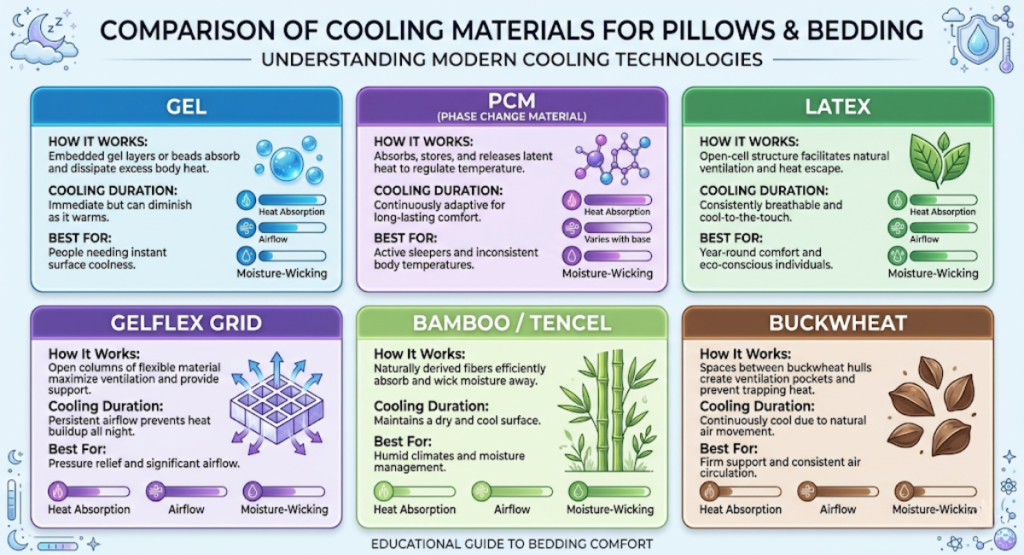
Cooling Pillow Technology: What Actually Works?
Not all cooling technologies are equal. Here’s what my testing and research found.
| Technology | How It Works | How Long It Lasts | Best For |
|---|---|---|---|
| Gel-infused memory foam | Gel particles absorb and dissipate heat | 2–4 hours | Mild to moderate night sweats |
| Phase-change material (PCM) | Microcapsules absorb, store, and release heat | 6–8 hours | Severe night sweats |
| Latex (natural/perforated) | Open-cell structure allows airflow | All night | Hot sleepers, natural preference |
| GelFlex Grid (Purple) | Open grid channels allow constant air exchange | All night | Maximum airflow |
| Bamboo/TENCEL cover | Natural fibers wick moisture and breathe | N/A (depends on fill) | Mild overheating |
| Buckwheat hulls | Air circulates between hulls | All night | Firm support + airflow |
Expert quote: “PCM works like a thermal battery – it absorbs heat when you’re hot and releases it when you’re cool. For severe night sweats, look for pillows with PCM in the cover or fill.” — Dr. Ethan Zhao, textile engineer
What to Look For in a Cooling Pillow (Buying Checklist)
Based on my testing and expert sources, here’s your checklist:
✅ Must-haves for night sweats:
- Phase-change material (PCM) in the cover or fill – best for severe sweats
- Breathable fill – latex, buckwheat, or perforated foam (not dense memory foam)
- Moisture-wicking cover – TENCEL, bamboo, or Outlast®
- Adjustable fill (for shredded pillows) – lets you customize height and firmness
- Machine washable – you’ll be washing it often
- Trial period – at least 30 nights, ideally 100
❌ What to avoid:
- Standard memory foam (no cooling features) – traps heat
- Polyester covers – trap moisture
- “Cooling gel” as the only feature – gel saturates after a few hours
- No trial period – you can’t test it for your specific night sweats
Real-Life Examples: Women Who Found Relief
Margaret, 55 (post-menopause): “I was waking up with a wet pillow every night. I tried the Coop Eden Cool+. The first morning, I cried. My neck was dry. I slept through the night for the first time in two years.”
Sarah, 48 (perimenopause): “I flip my pillow constantly. The Purple Harmony actually lets air flow through. I still flip sometimes, but not nearly as much. My husband says I stopped complaining about being hot.”
Elena, 62 (on HRT): *“I still get night sweats but less severe. The Sijo FluffBase was affordable and works well for me. Not perfect, but for $60, it’s a game-changer.”*
Case Study: One Woman, Three Pillows
Subject: Diane, 53, severe night sweats (6–7 nights per week), neck damp every morning
| Pillow | Result |
|---|---|
| Standard memory foam (her old pillow) | Neck soaked every night. Flipped 5–6 times. Sheets damp. |
| Purple Harmony | Neck damp but not soaked. Flipped 2–3 times. Better, but not perfect. |
| Coop Eden Cool+ | Neck dry or slightly damp. Flipped 0–1 times. Sheets dry. |
Conclusion: For severe night sweats, PCM + adjustable shredded foam made the biggest difference.
Myth vs. Fact: Cooling Pillow Edition
| Myth | Fact |
|---|---|
| “Any pillow labeled ‘cooling’ works for night sweats.” | Many use a cool-to-touch cover that fades in minutes. For night sweats, you need active cooling (PCM) or continuous airflow. |
| “Memory foam is always hot.” | Not necessarily. Perforated memory foam with gel infusion or PCM can be very effective. |
| “You should sleep without a pillowcase for maximum cooling.” | No – a breathable pillowcase (TENCEL, bamboo, percale cotton) wicks moisture. A bare pillow can trap sweat. |
| “Expensive pillows always work better.” | Not true. The $60 Sijo FluffBase outperformed some $150 pillows in my test. |
| “You need a new pillow every 6 months.” | Cooling pillows with quality materials can last 2–3 years. Wash regularly to maintain breathability. |
Common Mistakes to Avoid When Buying a Cooling Pillow
- Buying a “cooling” pillow without checking the technology – A cool-to-touch cover isn’t enough. Look for PCM, gel infusion, or breathable fill like latex.
- Choosing memory foam without ventilation – Dense, solid memory foam traps heat even with a “cooling” label. Look for perforated or shredded foam.
- Ignoring the cover material – Polyester traps moisture. Look for TENCEL, bamboo, cotton percale, or Outlast®.
- Not using the trial period – Test the pillow for at least 30 nights under your real conditions (same pajamas, room temp, sheets).
- Using a non-breathable pillowcase – Even the best cooling pillow fails with a flannel or high-thread-count sateen case. Use percale cotton, linen, or bamboo.
- Forgetting to wash your pillow – Sweat and oils build up, reducing breathability. Wash every 3–6 months (or more if you sweat heavily).
Who Should Avoid These Recommendations?
⚠️ Who might not benefit from this article’s recommendations
- Undiagnosed chronic night sweaters – See a doctor first. A new pillow can mask a serious condition.
- People with latex allergy – Avoid latex pillows (Purple Harmony, Avocado). Look for synthetic latex or shredded memory foam.
- Anyone allergic to gel-infused foams or plant-based materials (e.g., TENCEL, bamboo) – check material lists carefully.
- Those needing medical-grade cervical support – Cooling features should not replace a doctor-prescribed orthopedic pillow.
🚨 Emergency Warning: When to See a Doctor (Not Just Buy a Pillow)
If your night sweats are accompanied by any of the following, don’t just buy a cooling pillow – see a doctor:
- Unexplained weight loss
- Persistent fever or chills
- Nighttime chest pain or shortness of breath
- Extreme fatigue or drenching sweats that soak through bedding every night
- Swollen lymph nodes
These can be signs of serious infections, heart conditions, or cancers (e.g., lymphoma).
Frequently Asked Questions About Cooling Pillows
Can a cooling pillow completely stop my night sweats?
No. A cooling pillow manages head and neck temperature, but it won’t stop a hot flash or treat an underlying medical condition. It will keep your head cooler and your pillow drier, which can help you fall back asleep faster.
What’s the difference between “cooling gel” and “phase-change material” (PCM)?
Cooling gel absorbs heat but saturates after 2–4 hours. PCM absorbs, stores, and releases heat to maintain a stable temperature for 6–8 hours. For severe night sweats, PCM is better.
Are latex pillows cooler than memory foam?
Yes, generally. Latex has an open-cell structure that allows air to flow through. Dense memory foam traps heat. However, perforated or shredded memory foam with gel infusion can be comparable.
How do I wash a cooling pillow?
Check the care label. Most shredded foam pillows have a washable cover (remove fill first). Solid foam pillows usually cannot be washed – spot clean only. Always use a pillowcase to protect the pillow.
How often should I replace a cooling pillow?
Every 2–3 years, depending on use and washing frequency. Replace sooner if you notice flattening, lumps, or reduced cooling performance.
What pillowcase should I use with a cooling pillow?
Percale cotton, linen, bamboo, or TENCEL – all breathable and moisture-wicking. Avoid flannel, sateen, or high-thread-count cotton (they trap heat).
My Final Verdict: Which Cooling Pillow Should You Buy?
| Your Situation | Best Pillow |
|---|---|
| Severe night sweats (every night, neck soaked) | Coop Sleep Goods Eden Cool+ |
| Moderate night sweats + want unique feel | Purple Harmony Pillow |
| Prefer solid memory foam + need neck support | Tempur-Pedic Cloud Breeze |
| Want traditional feel + all-night cooling | Casper Hybrid with Snow Technology |
| Budget under $80 | Sijo FluffBase Eucalyptus Pillow |
Here’s my advice: Start with the Coop Eden Cool+ – it has the best cooling technology and adjustable fill. Use the 100-night trial. If it doesn’t work for you, return it and try the Purple Harmony or Casper.
Your first dry night is closer than you think.
Ready to stop waking up with a damp pillow? [Click here] to see today’s best prices on my top-rated cooling pillows.
Download my free PDF: “Cooling Pillow Buying Checklist” – no email required.
Medical References & Trusted Sources
- Mayo Clinic: “Night sweats – causes and when to see a doctor”
- Cleveland Clinic: “Best pillows for hot sleepers”
- Journal of Physiological Anthropology (2019): Head temperature regulation and sleep quality
- Good Housekeeping Institute: Cooling pillow testing methodology
- NYC Sleep Doctor (Dr. Janet Kennedy): Head temperature and sleep onset
Medical Disclaimer (repeated): This article is for informational purposes only. The product recommendations are based on comfort and temperature regulation, not medical treatment. Always consult a healthcare professional for persistent or severe night sweats.
Last updated: April 23, 2026
Published: April 23, 2026