

Resistance bands are an effective and versatile tool for enhancing your strength training at home. By incorporating these bands into your workouts, you can target various muscle groups while improving stability and flexibility. With the right exercises, you can develop strength, increase endurance, and promote muscle growth without the need for heavy weights. In this post, you’ll discover some of the best resistance band exercises that will help you maximize your training routine and achieve your fitness goals from the comfort of your home.
Key Takeaways:
- Resistance bands provide versatile resistance options for a full-body workout.
- Exercises can target all major muscle groups, enhancing strength and stability.
- They are portable, making them ideal for home workouts or travel.

Understanding Resistance Bands
Types of Resistance Bands
Resistance bands come in various types, each designed for different strength training needs. Common varieties include loop bands, tube bands with handles, therapy bands, and resistance bands with anchor points. Each type offers distinct benefits for your workouts, allowing for versatile exercise options.
- Loop bands: Great for lower body exercises and stretching.
- Tube bands with handles: Ideal for upper body strength training.
- Therapy bands: Often used for rehabilitation and gentle resistance.
- Resistance bands with anchor points: Perfect for versatility in home workouts.
- Flat bands: Good for mobility work and Pilates.
Knowing the variety of resistance bands enhances your ability to choose the right one for your fitness journey.
| Loop Bands | Excellent for strength training and stabilizing muscles. |
| Tube Bands | Versatile for various upper and lower body workouts. |
| Therapy Bands | Gentle resistance, suitable for rehabilitation exercises. |
| Anchor Resistance Bands | Allows for more dynamic movements in workouts. |
| Flat Bands | Great for Pilates and stretching routines. |
Benefits of Using Resistance Bands
Incorporating resistance bands into your routine offers numerous advantages. They are portable, affordable, and easy to use, making strength training accessible wherever you are. Moreover, they allow for a full range of motion, promoting flexibility and enhancing stability.
The versatility of resistance bands means you can perform an extensive range of exercises targeting different muscle groups, all while customizing the intensity to fit your fitness level. They improve muscle activation and can enhance your stability and balance by engaging core muscles during movements. Furthermore, resistance bands can be an effective tool for increasing strength without putting undue stress on your joints, making them suitable for all fitness levels, from beginners to advanced athletes. This adaptability makes resistance bands a valuable addition to your home workout regimen.
Preparing for Resistance Band Workouts
Choosing the Right Resistance Level
Selecting the appropriate resistance level is crucial for effective workouts. Bands typically have color-coded resistance levels ranging from light to heavy. Assess your current strength and fitness goals to find a band that challenges you but allows you to maintain proper form. By incorporating various resistance levels, you can progressively increase strength without risking injury.
Safety Tips for Using Resistance Bands
Prioritizing safety is crucial when using resistance bands. Inspect your bands before each session for any signs of wear or damage, and ensure that your grip is firm and secure. Avoid anchoring the bands to unstable surfaces, as this can lead to accidents. The tips below will enhance your safety during workouts:
- Always check for damage before use.
- Secure your grip to prevent slips.
- Avoid overstretching to prevent injury.
- Use anchor points that are stable.
Proper technique is crucial to prevent injury while using resistance bands. Engage your core during exercises and maintain controlled movements. If you experience any discomfort, stop immediately to assess your form or resistance level.
- Use controlled movements to reduce injury risk.
- Engage your core throughout exercises.
- Don’t push into pain; stop if necessary.
- Consult with a trainer if unsure.
Warm-Up Exercises for Optimal Performance
Before entering into your resistance band routine, warming up is vital for peak performance. Dynamic stretches, such as arm circles and leg swings, activate your muscles and increase blood flow. Incorporating these movements can enhance flexibility and reduce the risk of injury during your workout.
A proper warm-up not only prepares your body but also mentally readies you for the session. Aim for at least five to ten minutes of light cardio followed by dynamic movements. This may include jogging in place or performing jumping jacks, ensuring your heart rate rises gradually. Engaging in a thorough warm-up sets the tone for a successful workout and increases overall effectiveness.
Full-Body Resistance Band Exercises
Upper Body Exercises
Resistance bands are excellent for targeting the upper body, offering variations to strengthen your shoulders, arms, and chest. Try exercises like banded push-ups or overhead presses. Such movements not only build muscle but also improve stability. Ensure you maintain proper form to maximize benefits and minimize the risk of injury.
Lower Body Exercises
Incorporating resistance bands into lower body workouts can enhance your strength and stability, focusing on your glutes, quads, and hamstrings. Exercises such as banded squats and lateral band walks effectively engage these muscle groups, offering both resistance and support while performing movements that may otherwise strain your joints.
For optimal lower body workouts, consider pairing exercises like resistance band squats with glute bridges. Performing three sets of 12-15 repetitions for each movement can help you achieve better muscle activation. Focusing on slow, controlled movements allows for greater time under tension, promoting muscle growth and endurance.
Core Exercises
Core exercises using resistance bands can significantly enhance your stability and strength. Incorporate moves such as banded Russian twists or standing band anti-rotation presses. These exercises engage your entire core, improving both balance and posture during your workouts.
By integrating resistance bands into your core routine, you can challenge your muscles in unique ways. Performing two to three sets of 10-15 repetitions for each exercise will deepen your core engagement. This approach not only strengthens the abdominal muscles but also activates the obliques and lower back, contributing to overall functional strength.
Creating a Resistance Band Workout Routine
Structuring Your Workout
To create an effective workout routine, you should focus on balancing exercises that target all major muscle groups. Start by deciding on the number of sessions per week, ideally three to five, with each session lasting 30 to 60 minutes. Incorporate a mix of upper body, lower body, and core exercises, ensuring you include both pushing and pulling movements for well-rounded strength development.
Sample Full-Body Routine
A sample full-body resistance band routine might include exercises such as band squats, bent-over rows, chest presses, and seated band abductions. Aim for 10-15 repetitions per exercise, adjusting the resistance as needed for your fitness level. Perform 2-3 sets of each exercise, resting for 30 seconds between sets to maintain intensity.
This routine effectively targets multiple muscle groups while also improving balance and flexibility. By engaging both the upper and lower body, you enhance overall strength and functional movement patterns. You can modify each exercise by changing the resistance, adjusting your grip, or varying your stance to keep the workout challenging and interesting.
Tips for Progression
To continually challenge yourself, gradually increase the resistance, add more repetitions, or incorporate advanced movements. Keeping a workout log will help track your progress and identify when it’s time to intensify your routine. You might also consider integrating other training modalities like bodyweight exercises or stability challenges. The key is to push your limits without compromising form.
Using these progression strategies will lead to consistent improvements in your strength and fitness levels. Adjusting your workouts ensures continued adaptation, reducing plateaus and keeping you motivated to reach your goals. Here are some suggestions to incorporate:
- Increase resistance levels as you gain strength.
- Add more sets or repetitions over time.
- Combine bands with weights for varied resistance.
- Incorporate advanced exercises as you progress.
The goal is to keep challenging your body to achieve the best results.
Targeted Resistance Band Exercises
Exercises for Strengthening the Back
To strengthen your back, incorporate exercises like the resistance band row and reverse fly. These movements engage your upper back and improve posture by targeting key muscles including the rhomboids and rear deltoids. Ensure you maintain a strong, stable position to maximize effectiveness and prevent injury.
Exercises for Improving Leg Strength
For enhanced leg strength, use resistance bands for squats and lateral band walks. These exercises activate major muscle groups such as the quadriceps and glutes, offering a comprehensive lower body workout without heavy weights.
For example, performing resistance band squats can help you increase lower body stability. A proper stance ensures that your knees track over your toes while you engage the band. This maximizes tension throughout the exercise, promoting muscle hypertrophy and strength development in your legs. Incorporate 2-3 sets of 10-15 repetitions for optimal results.
Exercises for Enhancing Core Stability
Engage your core with resistance band exercises like the pallof press and seated rotation. These moves stabilize your midsection, enhancing your overall strength and balance, which is crucial for daily activities and athletic performance.
Incorporating resistance band exercises for your core not only improves strength but also supports injury prevention. For instance, when you perform the pallof press, you’re actively resisting rotation, which engages your obliques and deep abdominal muscles. Aim for 3 sets of 10 repetitions on each side to build a solid foundation and enhance functional stability.
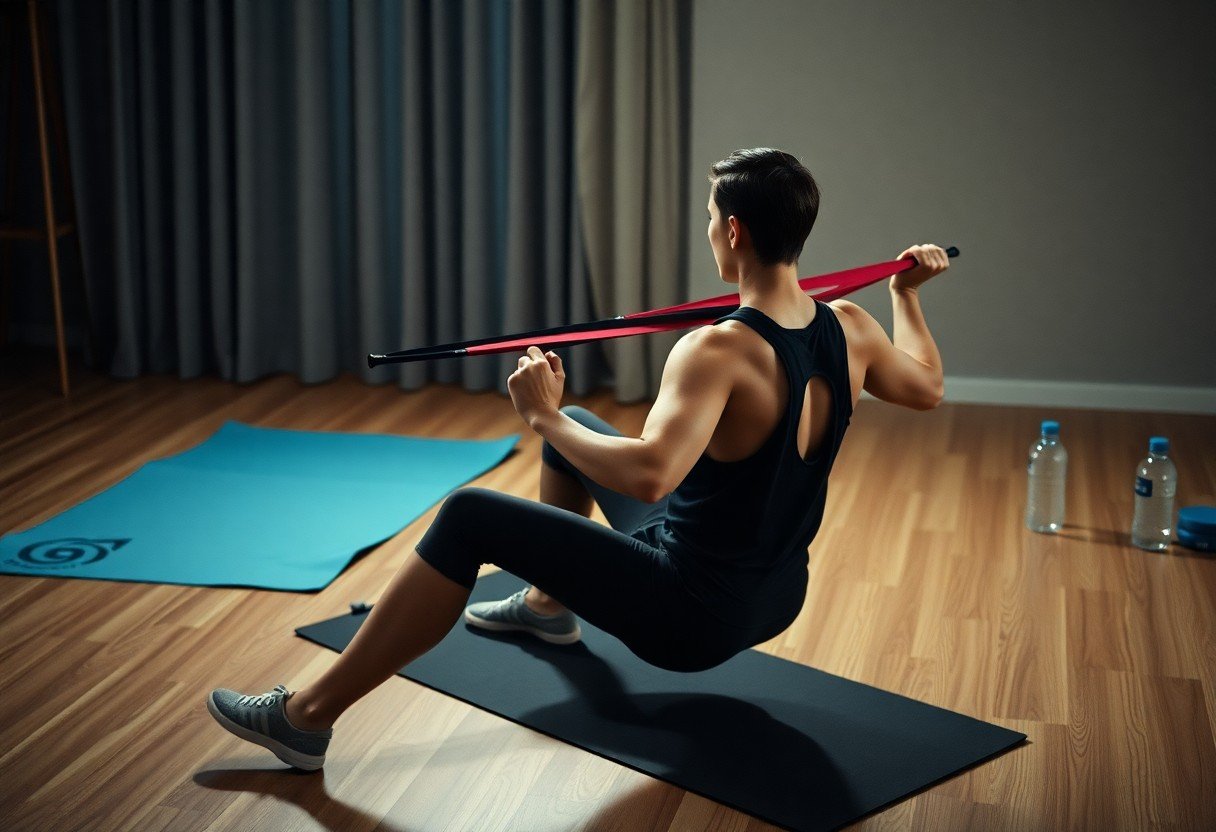
Advanced Resistance Band Techniques
- Single-Leg Deadlifts
- Overhead Press with Rotation
- Banded Squat Jumps
- Banded Push-Ups
- Seated Row with Pause
- Band-Resisted Lateral Lunges
- Face Pulls
- Tricep Extensions with Bands
- Band Assisted Pull-Ups
- Banded Plank to Push-Up
| Technique | Description |
| Single-Leg Deadlifts | Works on balance while targeting your hamstrings and glutes. |
| Overhead Press with Rotation | Enhances shoulder strength and stability. |
| Banded Squat Jumps | Increases power and explosiveness in your lower body. |
| Banded Push-Ups | Adds intensity to standard push-ups, engaging more muscles. |
| Seated Row with Pause | Focuses on your back muscles with an added challenge. |
Adding Plyometric Elements
Incorporating plyometric elements into your resistance band training can significantly enhance power output. Exercises like banded squat jumps or explosive push-ups challenge your strength while improving speed and agility. These high-impact movements not only engage multiple muscle groups but also elevate your heart rate for a more dynamic workout.
Using Bands for Stability Challenges
Stability challenges with resistance bands help improve your core strength and balance. By performing exercises like single-leg deadlifts or banded planks, you force your stabilizer muscles to work harder. This leads to better overall stability, which is beneficial for enhancing performance in other workouts and daily activities.
Incorporating resistance bands for stability challenges, such as during single-leg movements, increases the demand placed on your core. As you balance on one leg with band resistance, your abs, back, and hip muscles all engage to keep you steady. This not only aids in muscle development but also enhances your proprioception and coordination, making each movement more controlled.
Combining Resistance Bands with Other Equipment
Using resistance bands alongside other equipment, like dumbbells or stability balls, can amplify your workout. For instance, adding bands to a dumbbell squat or pairing them with a stability ball for core exercises creates a more comprehensive strength training routine.
This combination challenges your muscles differently and allows for greater versatility in your training. Bands can add extra resistance to traditional weightlifting exercises, while also encouraging better form and muscle engagement. This synergy between bands and other tools boosts the effectiveness of your workouts.
For more advanced resistance band moves, check out 12 Resistance Band Moves You Can Do at Home.
Conclusion
Now that you have explored the best resistance band exercises for home strength training, you can incorporate these effective movements into your routine to enhance your fitness journey. Utilizing resistance bands allows you to engage various muscle groups with versatility and ease, making it possible to workout effectively in the comfort of your home. By consistently including these exercises, you will build strength, improve flexibility, and achieve your fitness goals.
FAQ
Q: What are resistance bands?
A: Resistance bands are elastic bands used for strength training and rehabilitation. They come in various tensions and can be used for a wide range of exercises targeting different muscle groups.
Q: How effective are resistance band exercises for strength training?
A: Resistance band exercises can be very effective for strength training, providing progressive resistance similar to weights. They improve muscle strength, flexibility, and endurance, making them suitable for all fitness levels.
Q: What are some of the best resistance band exercises for beginners?
A: Effective beginner exercises include the seated row, squats, chest press, bicep curls, and lateral band walks. These movements target major muscle groups and help build foundational strength.
Q: Can resistance bands help with muscle tone and definition?
A: Yes, resistance bands can help improve muscle tone and definition. By consistently incorporating resistance band exercises into your routine, you can enhance muscle endurance and shape your physique over time.
Q: How do I choose the right resistance band for my workouts?
A: Select a resistance band based on your current strength level and comfort. Beginners may start with lighter bands, while more experienced users can opt for heavier bands. Consider bands with handles for added versatility and grip.